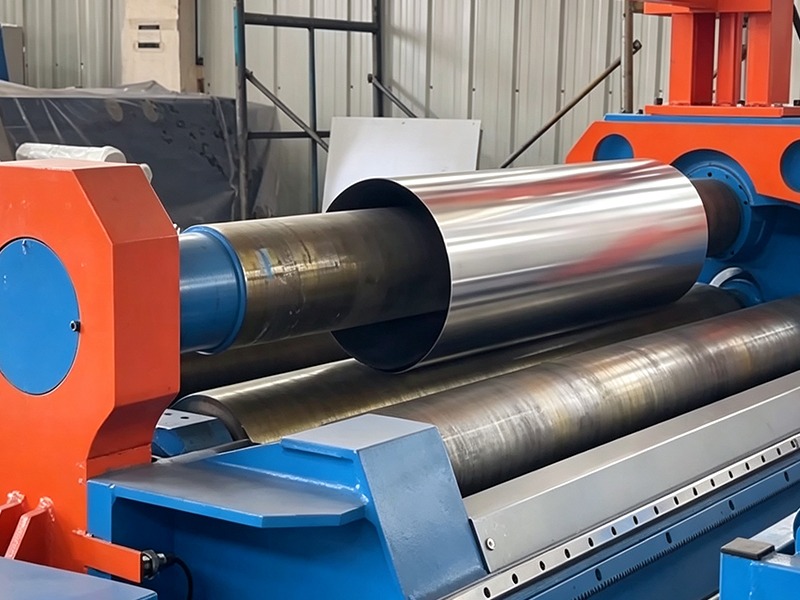
Stainless steel rolling is a sheet metal fabrication process in which flat 304, 316 and 201 stainless steel sheets are plastically bent using a CNC plate rolling machine to form cylindrical, conical and arched components.
Through repeated downward pressure from the rollers, combined with a pre-bending process to eliminate straight edges on the sheet, and the use of CNC programmes to compensate for springback, this process produces sealed, weldable cylindrical components. It is a core process in the manufacture of tanks, ductwork and equipment casings.
Points to Note When Rolling Stainless Steel Coils
Significant Springback
Stainless steel is highly elastic, with 316 exhibiting greater springback than 304; it is essential to use a CNC programme that accounts for springback, and the machining parameters for carbon steel must not be applied directly.
The Surface is Prone to Scratching
Polyurethane-coated rollers must be used on mirror-finished and brushed panels to prevent indentations and scratches caused by direct friction between the rollers and the surface.
Sheets are Prone to Slipping
Thin sheets and bright-finished sheets have low friction; it is preferable to use a four roller plate rolling machine to clamp the sheets in place, to prevent displacement causing the cylinder to become elliptical.
Difficulty in Processing Straight Edges
Conventional three-roll bending machines produce long straight edges at both ends, resulting in wide weld gaps; high-precision workpieces therefore require a pre-bending process.
Work Hardening
As the hardness of cold-rolled stainless steel increases with repeated rolling, springback becomes more pronounced; in such cases, progressive rolling with multiple passes may be employed.
Classification of CNC Plate Rolling Machines
CNC Symmetrical 3 Roller Plate Rolling Machine
The Principle of Roll Forming
The upper and lower rollers are arranged symmetrically; the upper roller applies pressure by moving vertically, whilst the sheet is fed in from both sides, causing bending deformation through the compression exerted by the upper and lower rollers.
As the sheet is unsupported at both ends, relatively long straight edges remain on both sides once the rolling process is complete; these ends must therefore be processed using a separate pre-bending fixture.
Key Features
– Simple structure, low body cost, low failure rate, and easy maintenance of the hydraulic CNC system;
– The upper and lower rollers rotate synchronously, ensuring balanced force distribution; high-tonnage models have strong load-bearing capacity;
– Limitations: In-machine pre-bending is not possible, and a large amount of straight edge material is required; thin stainless steel sheets are prone to slipping and misalignment, and the cylinder is prone to becoming elliptical;
– The CNC system only controls the vertical movement and rotational speed of the upper roller; it does not provide full-process sheet clamping functionality.
Applications
Suitable only for 304/316 stainless steel with a thickness of 6 mm or greater, and for rough machining of workpieces where high precision is not required for the straight seams of the cylinder body or the external finish: thick-walled chemical storage tanks, large standard tanks, and thick-plate cylinders. Not recommended for mirror-finished thin sheets or high-precision components for export.
CNC Asymmetrical 3 Roller Plate Rolling Machine
The Principle of Roll Forming
The two lower rollers are arranged in a staggered configuration, one higher than the other; the upper roller applies downward pressure whilst the side rollers are fine-tuned forwards and backwards, allowing the sheet to be clamped on one side by the rollers.
This enables short-distance pre-bending to be carried out within the machine, reducing the length of the straight edges at both ends, with the full circle being formed through multiple feed cycles.
Key Features
– Simple pre-bending can be carried out on the machine itself, significantly reducing the length required compared to symmetrical three-roll straight-edge bending, and no additional jigs are required;
– The machine has a compact design, takes up little floor space and is reasonably priced, making it suitable for small and medium-sized sheet metal workshops;
– Drawbacks: Clamping stability is inferior to that of four-roll machines; thin mirror-finished stainless steel is still prone to scratching and slipping; and there are limitations on the thickness of sheet metal it can handle.
Applications
Suitable for standard 304 stainless steel with thicknesses of 1–8 mm: dust extraction ducts, small water tanks, standard equipment casings, decorative cylinders; not suitable for thick 316 plates or workpieces with high specifications.
The upper roller is a driven universal roller capable of vertical lifting and horizontal fore-and-aft movement, whilst the two lower rollers rotate in a fixed position;
The upper roller is offset to one side to clamp the end of the sheet, thereby achieving complete pre-bending at both ends. Pressure, displacement and rotational speed are controlled hydraulically and via CNC throughout the process, with high pressure applied to induce plastic deformation in thick sheets.
Key Features
– Exceptional pre-bending capability, virtually eliminating straight edges; pre-bending and roll forming are carried out in a single, integrated process on a single machine;
– The machine features a heavy-duty frame and high hydraulic pressure, offering excellent resistance to deformation and supporting thick, high-strength sheet metal;
– The CNC system allows for the input of springback compensation programmes, making it suitable for stainless steel with high springback;
– Disadvantages: the machine is heavy, resulting in higher purchase costs, and offers poor value for money when processing thin sheets.
Applications
Specialising in 12–35 mm medium-to-thick 304/316 stainless steel: corrosion-resistant chemical storage tanks, boiler shells, pressure vessels and heavy-duty equipment cylinders; for high-hardness 316 thick plates, select a three-roll universal mill.
CNC 4 roller Plate Rolling Machine
The Principle of Roll Forming
One main roller at the top and one at the bottom, plus one side roller at the front and one at the rear; these four rollers operate independently via an integrated CNC system;
Once the metal sheet is fed into the machine, the front and rear side rollers clamp both sides of the sheet and maintain a secure grip throughout the entire processing operation without loosening; the upper roller presses down to bend the metal sheet, whilst the side rollers at both ends push the sheet to complete the initial bending at both ends; a complete circle can be formed directly with just a single clamping operation.
Key Features
– The sheet metal is clamped throughout the entire process, ensuring no slippage or deviation, and achieving the highest precision in cylinder roundness;
– Synchronised pre-bending at both ends results in virtually no straight edges requiring welding, eliminating the need for secondary jigs;
– Polyurethane-coated rollers can be fitted to prevent indentations and scratches on the stainless steel sheet surface;
– The CNC system features built-in springback compensation specifically for stainless steel, along with multi-pass progressive rolling programmes, perfectly counteracting the springback of 304/316 grades;
Suitable for all thicknesses of stainless steel from 0.3 to 16 mm, and particularly well-suited to workpieces with stringent requirements: mirror-finished or brushed thin-gauge sheet metal air ducts, aseptic food storage tanks, high-precision cylindrical components for export, and small decorative circular parts;
It is the preferred choice for thin sheets, 316 grade material and workpieces with high aesthetic standards.
Selection Comparison Table
Stainless Steel Thickness
Recommended Models
Advantages
Workpieces
0.3~2mm
Small CNC Four Roller Plate Bending Machine
Rubber-coated to prevent scratches, no straight edges, automatic springback compensation
When rolling stainless steel coils, the choice of CNC rolling machine should be based primarily on the sheet thickness, surface finish and finished product requirements. It is recommended to fit the machine with polyurethane-coated rollers and a CNC springback compensation programme, which effectively reduces springback and scratches whilst ensuring consistent forming accuracy of the cylindrical workpiece.
About Us
Based in Jiangsu, China, Chuangtu is an original equipment manufacturer specialising in sheet metal forming machinery for over a decade. Having obtained CE certification, ISO 9001 quality management certification and numerous invention patents, the company has built a strong reputation in the indust...