What Is a 4 Roller Plate Rolling Machine?
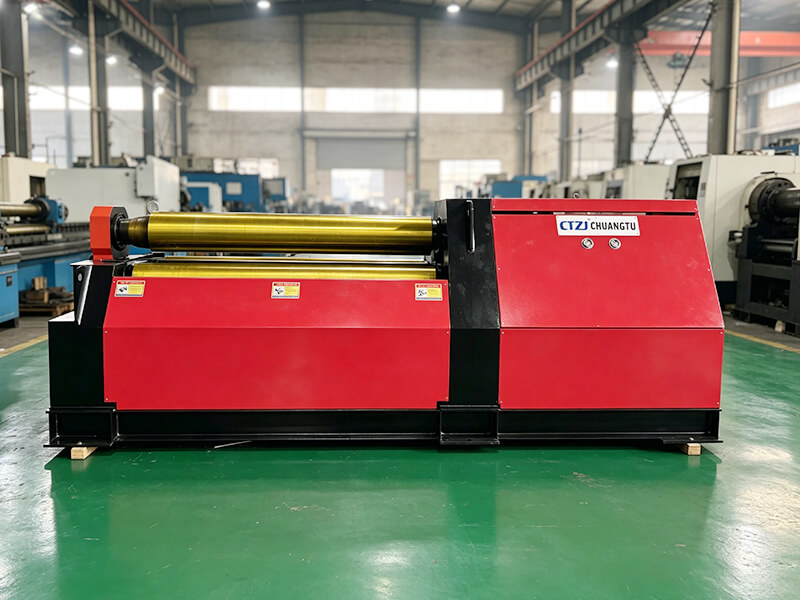
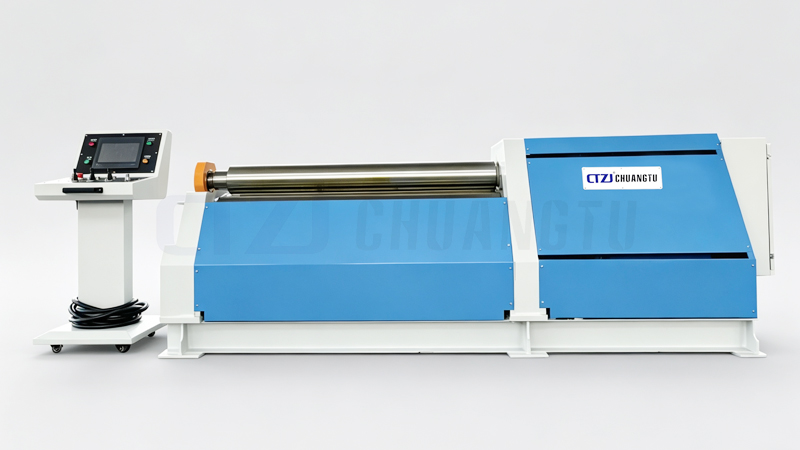
A 4 roller plate rolling machine is a specialized forging and pressing machine designed for bending and forming sheet metal. It consists of four working rolls — the upper roll, lower roll, left side roll, and right side roll — which use compression and rotation to bend flat metal sheets into cylinders, curved parts, and conical workpieces.
How 4 Roller Plate Rolling Machine Work
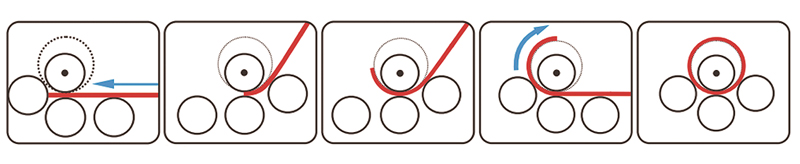
The sheet metal is fed between the upper and lower rollers; the lower roller moves upwards to clamp the sheet, providing the friction required for feeding.
The rollers on both sides perform an inclined lifting motion, applying an upward bending force to both sides of the sheet.
The rotation of the rollers drives the sheet in a reciprocating feed; the lifting height of the rollers on both sides determines the bending radius of the cylinder.
At the feed end, the side rollers are used to pre-bend one end of the sheet; after the sheet is turned, the other end is pre-bent; the entire process—pre-bending, rolling and rounding—is completed on a single machine, without the workpiece needing to be removed from the 4 roller plate rolling machine.
The upper roller serves as the main drive and generally maintains a fixed centre height; the lower roller is responsible for clamping, whilst the left and right side rollers are responsible for bending and adjusting the curvature.
Structural Components of 4 Roller Plate Rolling Machines
Server Rack
Left and right side panels + fully welded base; stress-relieved by annealing after welding to ensure the rigidity of the entire unit and prevent deformation under heavy loads.
Four Working Rollers
Upper roller, lower roller, left-hand roller and right-hand roller; the main material is 42CrMo, forged and tempered, offering wear resistance and torsional strength.
Tilting and Dumping Mechanism
The upper roller bearing housing tilts to allow the workpiece to be removed directly once the cylinder has been wound, without the need to extract the cylinder.
Hydraulic Drive System
Hydraulic cylinders drive the clamping of the lower roll and the lifting and tilting of the side rolls; hydraulic valve block and hydraulic power unit.
Drive System
The main motor, gearbox and gear pair drive the rollers to rotate and feed the material.
Control System
Standard digital display / PLC-based numerical control, displacement encoder, displaying the position of each roller, fault alarmc.
Auxiliary Supports
Roller supports, frame guards, safety limit switches.
Types and Features of Four-Roll Plate Bending Machines
Standard Hydraulic Digital Display 4 Roller Plate Rolling Machine
– Drive: Fully hydraulic drive; digital display showing roller positions; no automatic programming.
– Features: Excellent value for money; parameters are entered manually; suitable for small to medium production runs; operators require some experience; pre-bending, rolling and straightening are all carried out by a single machine.
– Applications: General steel structures and standard cylindrical sections.
CNC 4 Roller Plate Rolling Machine
– Drive: Hydraulic + PLC control system, servo displacement control, storage of workpiece process programmes, automatic calculation of side roller lift.
– Features: High precision, with displacement synchronisation accuracy of up to ±0.2 mm; capable of storing multiple sets of workpiece parameters to minimise human error, making it suitable for batch production; supports conical rolling programmes.
– Applications: Pressure vessels, batch-produced tanks, and workpieces with high precision requirements.
Small 4 Roller Plate Rolling Machine for Thin Sheets
– Drive: Hydraulically driven, compact design; suitable for small-diameter cylinders made from thin sheets.
– Features: Compact footprint, excellent pre-bending results, minimal risk of straight edges; not suitable for thick sheets.
Heavy Duty 4 Roller Plate Rolling Machine
– Drive: High-flow hydraulic system, reinforced rollers, additional centre support rollers; plate width 3,000–10,000 mm, suitable for thick plates.
– Features: Heavy overall weight and extremely high rigidity; suitable for thick and wide steel plates; requires a robust factory foundation.
– Applications: Shipbuilding, large storage tanks, large pressure vessels.
Factors to Consider When Selecting a 4 Roller Plate Rolling Machine
Maximum Sheet Thickness
Determine the maximum sheet thickness for actual processing; for stainless steel sheets, the rolling capacity must be multiplied by a factor of ×0.6–0.7; for high-strength steel, calculate based on the yield strength.
The pre-bending thickness is often less than the nominal rolling thickness; it is essential to confirm the pre-bending capacity.
Maximum Sheet Width
The sheet width must be less than the effective roller surface length of the machine; the width of the machine’s roller surface must be ≥ the width of the workpiece plus an allowance of 100–200 mm.
Yield Strength of Sheet Metal
Q235: 245 MPa; 304 stainless steel: 310 MPa; high-strength steel has a higher yield strength; the higher the yield strength, the thinner the sheet metal that can be processed.
Minimum Reel Diameter
The minimum reel diameter is generally approximately 1.1–1.5 times the diameter of the upper roller; to achieve a smaller reel, the diameter of the upper roller must be increased.
Pre-bending Requirements
The key advantage of the 4 roller Plate rolling machine is end pre-bending; it is essential to confirm that the machine is capable of pre-bending the specified plate thickness; pressure vessel workpieces have strict requirements regarding the straight edges of pre-bent sections.
Workpiece Types: Cylinders / Cones / Curved parts
As cones need to be rolled, the equipment must be capable of cone rolling.
Roller Material
Preferably use 42CrMo forged and tempered rollers; avoid standard solid round steel rollers, as these are prone to bending under heavy loads.
Factory Premises Requirements
Total height and length of equipment, total weight of the unit, hoisting clearance, floor load-bearing capacity; for hydraulic equipment, provision must be made for cooling and power requirements.
Optional Equipment List for 4 Roller Plate Rolling Machine
– Sheet feed conveyor : Assists with the loading of large sheets, reducing the need for manual handling.
– Discharge support frame: Provides support during the rolling process in a 4 roller plate rolling machine, preventing the workpiece from falling or deforming.
– Wireless mobile handheld control unit: Enables remote operation and monitoring of the workpiece’s rolling status.
– Specialised accessories for conical rolling: Material stops and limiters for conical rollers.
– Specialised rollers: Scratch-resistant rubber-coated rollers, suitable for aluminium sheets and mirror-polished stainless steel sheets.
Reference Table for Selecting 4 Roller Plate Rolling Machine
Selecting a 4 Roller Plate Rolling Machine By Industry
Conclusion
As a core piece of equipment for high-precision cylinder rolling, the 4 roller plate rolling machine is capable of completing the pre-bending of both ends of the plate, rolling it into a circle and rounding it in a single clamping operation. It produces workpieces with minimal remaining straight edges and high precision, and is widely used across a range of industries.
When procuring and selecting a 4 roller plate rolling machine, one should not rely solely on the maximum plate thickness stated on the equipment nameplate. Instead, a comprehensive assessment must be carried out, taking into account processing conditions, sheet material, workpiece specifications, production modes and supporting equipment. This approach helps to avoid the waste of resources caused by selecting an oversized machine, or the high failure rate resulting from long-term overloading due to an undersized machine.