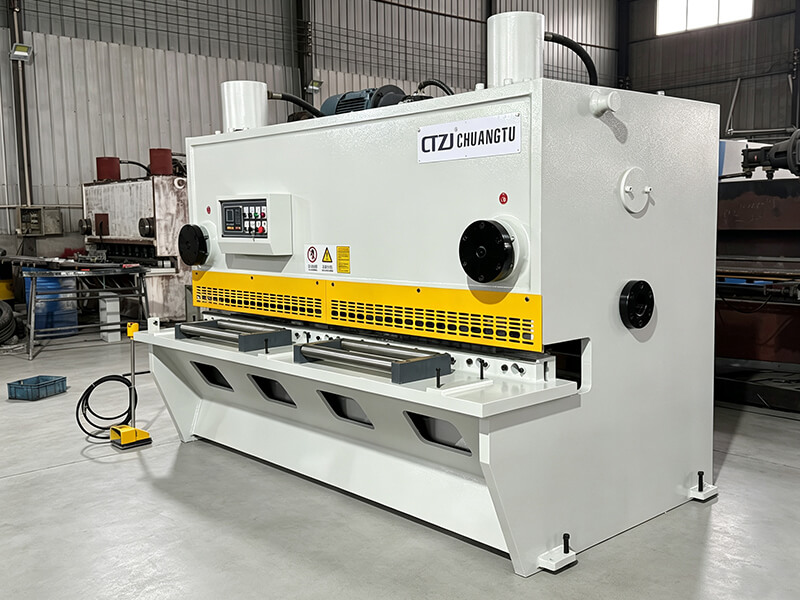
CNC shearing machines are a type of automated sheet metal cutting equipment,it performs precise straight-line cutting, blanking, trimming and slitting of various types of metal sheets, including stainless steel, carbon steel, aluminium sheets and copper sheets, enabling the batch processing of standardised, high-precision sheet metal cutting operations.
How a CNC Shearing Machine Works
The core principle of a CNC shearing machine is based on the principle of plastic fracture during the shearing of metal sheets. By precisely controlling the drive mechanism via the CNC system, the machine carries out a fully automated process comprising clamping, positioning, shearing and resetting of the sheet metal. This process is divided into four main steps:
Programming Positioning
Once parameters such as cutting length, width, thickness and number of cuts are entered into the CNC system, the system automatically calculates the cutting force, tool carriage stroke and rear stop position, and drives the servo mechanism to achieve precise positioning with an accuracy of up to ±0.1 mm.
Clamping of Sheet Material
The machine’s clamping cylinders operate synchronously to drive the clamping feet to press the sheet to be processed vertically, thereby securely locking the sheet in place. This prevents any displacement or vibration of the sheet during the shearing process, ensuring dimensional accuracy.
Shearing
The hydraulic system provides high-pressure power to drive the upper blade holder and upper blade downwards, whilst the lower blade, fixed to the worktable, remains stationary; the upper and lower blades form a shearing angle, applying a shearing force to the sheet metal. When the external force exceeds the sheet metal’s shear strength, the sheet metal undergoes plastic fracture, thereby completing the cutting process.
Automatic Reset
Once shearing is complete, the blade holder automatically retracts, the hold-down foot is released, the rear stop returns to its original position, and the machine proceeds to the next shearing cycle, enabling continuous, automated batch processing.
Structural Components of a CNC Shearing Machine
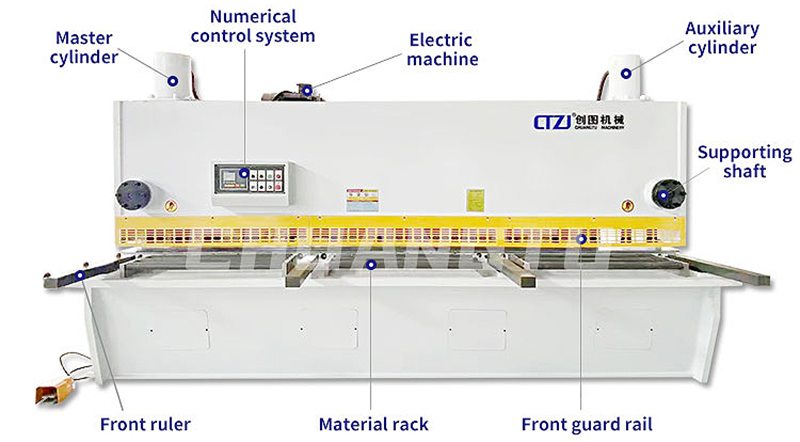
Frame
A fully welded steel plate frame comprising left and right side panels, a worktable and a base, designed to withstand shear loads and ensure rigidity.
Worktable
Designed to hold sheet metal; the surface is fitted with material-supporting balls and a material-stopping reference plate to reduce sliding friction.
Blade Holder
Holds the upper blade and is driven by a hydraulic cylinder to move up and down in a reciprocating motion; this is the cutting actuator.
Rear Stop Mechanism
A core mechanical component of the CNC system, driven by a servo motor and ball screw guide. It enables CNC positioning to set the sheet cutting length and can move automatically forwards and backwards, with feedback from a linear encoder.
Clamping Device
Multiple sets of hydraulic clamping cylinders secure the sheet metal prior to shearing to prevent it from shifting or warping, thereby ensuring dimensional accuracy.
Hydraulic System
Hydraulic cylinder + hydraulic pump + pressure valve assembly + oil tank: these components provide the power for shearing and control the downward movement, pressure maintenance and return stroke of the blade holder.
CNC Control System
CNC control panel for a specialised shearing machine; enter the cutting length, number of cuts and gap parameters.
The blade carriage moves vertically in a straight line, rising and falling like a gate.
Advantages:
High cutting precision, minimal sheet distortion; narrow strips are less prone to twisting or deformation; straight cross-sections with excellent straightness
The cutting angle is infinitely adjustable via CNC; for thick sheets, a larger angle reduces cutting resistance; for thin sheets, a smaller angle ensures flatness
High rigidity of the machine body, suitable for thick plates and high-strength materials (Q345, high-strength steel, stainless steel)
Blade clearance can be adjusted automatically via electric or CNC control; all four cutting edges of the blade can be utilised, extending blade life
The blade holder swings in an arc around a pivot point, with the blades cutting at an angle; this is the most widely used, cost-effective CNC model on the market.
Advantages:
Simple structure, low overall cost, excellent value for money and easy maintenance.
Fast idle stroke and high efficiency in continuous cutting of thin sheets.
Relatively lightweight, compact footprint, easy to install and minimal foundation requirements.
Mature hydraulic system with low failure rate and effective control of burrs on thin sheets.
Technical Specifications for CNC Shearing Machine
Projects
Parameter range
Maximum shearing thickness
4 mm–30 mm (carbon steel)
Maximum cutting width
1600 mm–6000 mm
Rated shear force
400 kN–4,000 kN
Rear stop positioning accuracy
±0.05 mm – ±0.1 mm
Number of cutting cycles
8–20 per minute
Blade clearance adjustment range
0–5 mm
Cutting angle
Adjustable from 1° to 3°
Main motor power
5.5 kW–45 kW
Factors to Consider When Selecting a CNC Shearing Machine
Processed Sheet Metal
Thin sheets, limited budgets, standard sheet metal work: swing-type hydraulic CNC shears.
Shearing straightness and burrs on cut edges: Cosmetic components and precision sheet metal work have stringent requirements regarding burrs; attention must be paid to frame rigidity, blade material and the method of gap adjustment (manual, electric or CNC automatic gap adjustment).
Rear stop positioning accuracy: Closed-loop control utilising a CNC system, servo motors and a linear encoder ensures better dimensional stability during high-volume cutting.
Repeatability of positioning must be taken into account for mass production.
Efficiency Requirements
Daily cutting frequency and continuous operating time: For prolonged production at full capacity, prioritise models with high rigidity and excellent hydraulic heat dissipation.
Whether automation options are required: Front feeding device, material support rack, scrap hopper, automatic sorting, and integration with production lines.
Cutting speed: Mechanical shears are fastest for thin sheets; servo models offer rapid response; guillotine shears are slightly slower for thick sheets.
Cost
Toggle shears are inexpensive, guillotine shears are in the mid-to-high price range, and fully servo-driven shears are the most expensive.
List of Optional Configurations for CNC Shearing Machine
Optional configurations
Function
Servo Rear Stop Upgrade
Improves positioning speed and accuracy, supports multi-stage automatic shifting, and minimises repeatability error
Electric Blade Gap Adjustment
No need for manual adjustment; adapts to different sheet thicknesses at the touch of a button, saving time and ensuring precision
Automatic Feeding Platform
Enables automatic feeding and continuous shearing of sheet metal, reducing manual intervention and improving efficiency
Sheet Support Device
Supports extra-long, thin sheets, preventing sagging and deformation, and ensuring flatness during shearing
Safety Light Curtain Protection
The equipment comes to an emergency stop when human-machine interference is detected, thereby preventing accidents and enhancing workplace safety
Hydraulic Oil Temperature Cooling System
Controls the oil temperature in the hydraulic system to prevent power loss and oil leaks caused by high temperatures, and ensures stable equipment performance
CNC Operating System
Supports programme storage, one-touch recall, self-diagnostic testing and touchscreen operation, making operation more convenient
Output Receiving Platform
Automatically receives sheets that have been cut, preventing them from being knocked or deformed, and facilitating material collection
Selecting a CNC shearing machine by industry
General Sheet Metal、 Enclosures and Cabinets、 Electrical Distribution Board Industry
Sheet metal processed: cold-rolled sheet, galvanised sheet, aluminium sheet, thickness 0.5–8 mm; batch cutting for the manufacture of cabinet bodies, housings and electrical distribution boxes.
Stainless Steel kitchenware、 Decorative Projects、 Hotel Equipment
Sheets to be processed: 201/304 stainless steel sheet and aluminium sheet, 0.6–6 mm; stainless steel is prone to work hardening, so strict requirements apply regarding burrs and surface scratches.
Recommended machine type: CNC guillotine shears
Construction machinery、 Mining Equipment、Pressure Vessels
Materials to be processed: Q345, high-strength steel, thick plates 6–25 mm; large-width blanks, heavy loads.
Sheet metal processing: 0.3–3 mm thin sheets; small workpieces; batch cutting of multiple specifications.
Recommended machine types: small CNC swing-type shears; for small or large batches, CNC mechanical shears may be used
Automotive Components、Rail Transport、 New Energy Sheet Metal
Sheet metal to be processed: high-strength aluminium, high-strength steel; high precision required; strict reference requirements for subsequent welding and bending
Recommended models: high-precision CNC guillotine shears (closed-loop encoder); for high-end production lines, fully servo-driven CNC shears may be selected
Conclusion
CNC shearing machines are used for straight-line cutting of sheet metal; the two main types are swing-type and guillotine-type. The CNC servo system ensures precise positioning, whilst the hydraulic system provides the cutting force; the hold-down feet securely clamp the sheet metal in place to ensure cutting accuracy.
About Us
Based in Jiangsu, China, Chuangtu is an original equipment manufacturer specialising in sheet metal forming machinery for over a decade. Having obtained CE certification, ISO 9001 quality management certification and numerous invention patents, the company has built a strong reputation in the indust...