Which Plate Rolling Machine Should Be Chosen for Rolling the Cylinders of Pressure Vessels?

Blog 2026-09-12 173
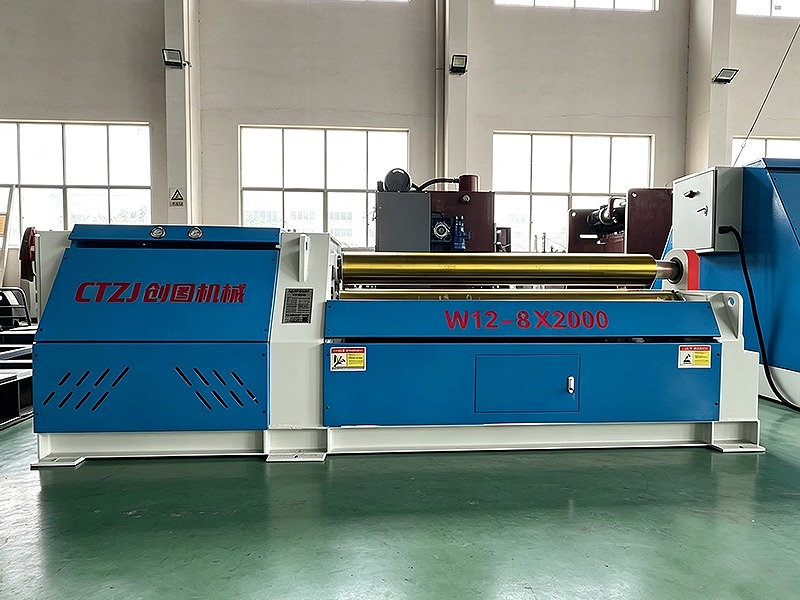
The core components of pressure vessels—such as the cylinder, heads and cylinder sections—are all formed into circular shapes using a plate rolling machine.

The rolling process is the first key stage in the production of pressure vessels; it directly determines the roundness, straightness and alignment accuracy of the cylinder, as well as its overall pressure-bearing safety.

Different CNC plate rolling machines are suited to pressure vessel production scenarios involving different materials, thicknesses and production capacities.

Pressure vessel plate rolling machine

Working Principle of a Pressure Vessel Plate Rolling Machine

CNC plate rolling machines utilise the mechanical pressure and rotational traction of the rollers to induce controlled elastic and plastic deformation in steel plates, ultimately forming them into standard cylindrical or conical structures, with parameters precisely controlled throughout the process by a CNC system.

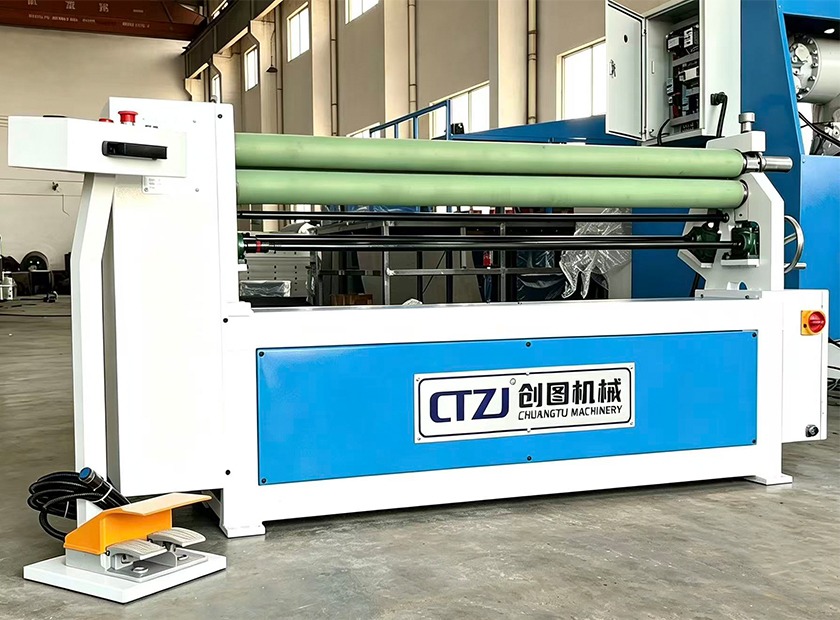
3 roller plate rolling machine
Forming is achieved by the upper roll pressing downwards whilst the two lower rolls rotate passively; the plate must be turned over for a second pass to complete the bend;

4 roller plate rolling machine
With auxiliary positioning and pre-bending provided by the side rolls on both sides, the entire rolling process can be completed in a single pass without the need to turn the plate over, resulting in higher forming accuracy and efficiency.

Types of Pressure Vessel Plate Rolling Machine
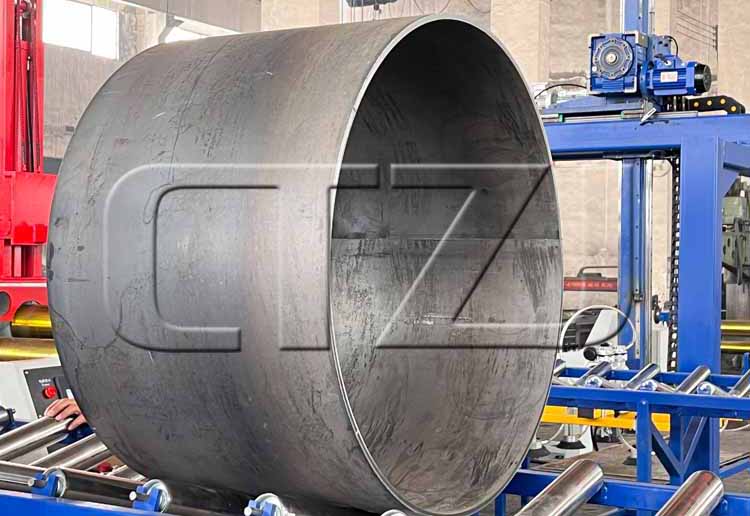
CNC plate rolling machines designed for the manufacture of pressure vessels are broadly categorised into three types, each differing in terms of structure, performance and suitable applications.

Cnc Symmetrical 3 Roller PlateRolling Machine

– Equipment Positioning

An economical, general-purpose plate rolling machine designed for high cost-effectiveness and low failure rates; it is an essential model for standard mass production.

– Structural Features

Features a symmetrical three-roll design with a vertically adjustable top roll and two fixed, symmetrically driven bottom rolls. The overall structure is simple yet rigid, ensuring easy maintenance and low operating costs.

– Core Performance

Equipped with a basic CNC system supporting variable speed control and process parameter memory. It operates stably and is capable of standard rolling tasks for typical medium-to-thick carbon steel plates.

– Limitations

Limited end pre-bending capability results in residual straight edges at both ends of the plate, requiring manual secondary correction; overall forming precision is moderate.

– Application Scenarios: Suitable for low-pressure operating conditions; widely used in the standardized mass production of small, conventional pressure vessels.

Cnc Asymmetrical 3 Roller Plate Rolling Machine

– Equipment Positioning

An upgraded symmetrical three-roll model offering a balance of performance and cost-effectiveness; it is a mainstream choice for small and medium-sized manufacturers.

– Structural Features

 Features an optimized roll structure; the bottom roll supports independent vertical adjustment on either side and tilting, specifically addressing the inherent pre-bending limitations of traditional three-roll designs.

– Core Performance

Utilizes a fully hydraulic drive combined with precise CNC control, ensuring accurate compensation for plate springback and excellent forming uniformity. It offers significantly enhanced pre-bending capabilities, minimizes residual straight edges, and is capable of processing thin plates and small-diameter cylinders.

– Limitations

Compared to four-roll machines, there is still a gap in precision and automation levels; it cannot meet the requirements for high-precision or ultra-large cylinder fabrication.

– Application Scenarios

Widely used in the production of small-to-medium-sized medium- and high-pressure vessels, and suitable for the vast majority of mid-range plate rolling applications.

Cnc 4 Roller Plate Rolling Machine

– Equipment Positioning

 High-end, specialized precision equipment for pressure vessels, featuring high precision, full automation, and high efficiency; designed for the manufacturing of high-end special equipment.

– Structural Features

Comprises a four-roll configuration (top roll, bottom roll, and left/right side rolls) equipped with a fully hydraulic servo CNC system, ensuring precise construction and intelligent control.

– Core Performance

Supports single-feed operation without the need for workpiece flipping, enabling fully automated forming throughout the process and achieving zero straight-edge ends (eliminating the need for separate end pre-bending). It delivers exceptional precision in cylinder roundness and straightness, and is capable of processing high-strength materials—such as stainless steel and alloy steel—as well as large-diameter, thick-walled cylinders.

– Equipment Advantages

Significantly outperforms various 3 roller plate rolling machine in terms of automation, forming precision, and production efficiency, offering superior processing capabilities.

– Application Scenarios

 Specialized for the high-precision manufacturing of medium-to-high-pressure vessels, large-scale special equipment, and high-end precision pressure vessels.

Performance Comparison of Pressure Vessel Plate Rolling Machine

Comparison cnc symmetrical 3 roller plate rolling machine cnc asymmetrical 3 roller plate rolling machine cnc 4 roller plate rolling machine
Pre-bending capacity Weak, with clearly visible straight edges Strong, with minimal residual straight edges Extremely strong, with no straight edges; precise pre-bending in a single operation
Moulding accuracy Standard: roundness error ≤ 3 mm/m Good: roundness error ≤ 1.5 mm/m High: roundness error ≤ 0.8 mm/m
Panel Compatibility Mild carbon steel, medium- and heavy-gauge plates, standard thicknesses Carbon steel, standard stainless steel, small- and medium-gauge plates Carbon steel, stainless steel, alloy steel, high-strength heavy-gauge plates
Production efficiency Low Medium High
Rebound compensation capability Poor Good Accurate

As pressure vessels are classified as special equipment, the cylindrical forming process is subject to specific requirements in three key areas: precision, appearance and structural strength.

Moulding Accuracy

The roundness error of the cylinder must be ≤ 1 per cent of the cylinder’s diameter, and the maximum error must not exceed 2 mm/m;

The straightness deviation of the cylinder must be ≤ 1.5 mm/m, and there must be no defects such as ovality, distortion or localised bulging;

No Straight Edges/No Defects

The cylinder body must not have excessively long straight edges; the pre-bent ends must conform to the standard curvature to prevent stress concentrations after welding;

During the rolling process, the surface of the sheet metal must be free from indentations, scratches, creases and cracks; stainless steel sheets must be properly protected against scratches to eliminate any risk of corrosion.

Rebound Control

Sheets with high springback, such as stainless steel, show no significant springback deformation after being rolled into a circle; they exhibit excellent dimensional stability after forming and remain distortion-free during long-term use, making them suitable for high-pressure applications.

Recommendations for Selecting Pressure Vessel Plate Rolling Machine

Production Scenarios Recommended Models Compatible Materials
Small, low-pressure vessels Cnc Symmetrical 3 Roller PlateRolling Machine Suitable for Q235 and Q345R ordinary carbon steel; plate thickness ≤16 mm, large-diameter cylinders, small-batch production.
Small-to-medium-sized, medium-to-high-pressure vessels Cnc Asymmetrical 3 Roller Plate Rolling Machine Suitable for standard carbon steel and ordinary stainless steel plates; plate thickness of 6–25 mm, small-to-medium diameter cylinders, and medium-scale production.
Large-scale, high-pressure, and precision pressure vessels Cnc 4 Roller Plate Rolling Machine Suitable for special plate materials such as stainless steel, alloy steel, and low-temperature high-strength steel; accommodates plate thicknesses of 20mm and above, large-width/small-diameter cylinders, and high-volume precision mass production.

Price Range for Pressure Vessel Plate Rolling Machine

The following are the price ranges for pressure vessel plate rolling machines in 2026 (for reference only).

Equipment Machining Specifications Price Range (US Dollar) Suitable Scenarios
cnc symmetrical 3 roller plate rolling machine Sheet thickness: 6–20 mm; sheet width: 1,500–3,000 mm 450~22350 Economy-class machines, suitable for small pressure vessels
cnc asymmetrical 3 roller plate rolling Machine Sheet thickness: 8–30 mm; sheet width: 2,000–3,000 mm 22350~52150 Mid-range mainstream machines, suitable for small and medium-sized pressure vessels
cnc 4 roller plate rolling machine Sheet thickness 10–40 mm, sheet width 2,000–3,000 mm 52150~119200 High-end models, suitable for high-pressure and stainless steel pressure vessels
heavy duty cnc 4 roller plate rolling machine Heavy-gauge sheets with thicknesses of 40–120 mm and large widths 119200+ Large-scale heavy-duty pressure vessels and specialised thick-plate equipment

Conclusion

When selecting a plate rolling machine for pressure vessels, the primary considerations are material characteristics, precision requirements, and equipment cost, in order to choose a model suited to specific production conditions.

Get Free Quote